The Context-First Legal Department
The home for ai-native

A Strategic Buyer's Guide to Cutting the AI Noise and Solving the Context Tax
Contents
The New Mandate
Why Legal Needs Purpose-Built AI
Point Solutions vs. Platforms
The Context Tax
Modern Infrastructure
The Future Legal Department
Tactical Execution with Sandstone
The Success Framework
The Ethics of Intelligence
Conclusion
The New Mandate
03From Reactive Outpost to Strategic Control Tower
For the modern legal leader, the current landscape is defined by a paradox: departments have more tools than ever, yet less time to think.
Legal departments are currently the “squeezed middle” of the corporate world. Departments are expected to manage enterprise-level risk with the lean agility of a startup. Now, a new pressure has arrived: the AI Mandate. Whether it's a directive from the Board to “modernize” or a push from the CFO to find “efficiency gains,” the message is clear: the status quo is no longer an option.
But “AI” is a broad and often hollow term. This guide is designed to cut through the hype of Large Language Models; it is about the architecture of intelligence. It is about how to move from being a reactive cost center to a unified control tower—where context is captured, institutional memory is preserved, and legal is finally freed from the “Context Tax.”

Why Legal Needs Purpose-Built AI
04The “More with Less” Reality Check
Every department is being asked to optimize. However, when Legal is asked to be “efficient,” just cutting costs is not an option; you must manage the structural integrity of the company.
General-purpose AI is designed for general-purpose work. It can draft an email or summarize a generic article. But legal work is unique, precarious, and interconnected.
The Connected Tissue
Legal touches every department—from Sales and HR to Product and Finance. A siloed AI tool cannot understand the ripple effects of a single clause across these functions.
The Sensitivity Factor
Legal data is the most critical in the organization. It is too sensitive to be fed into general models and too critical to be buried in disconnected folders.
The Reality Check
General-purpose AI understands legal theory, but it lacks institutional memory. It cannot recognize the bespoke redlines an organization has historically required, nor can it calibrate for specific risk appetites concerning indemnity. Deprived of this institutional context, AI merely accelerates the delivery of incomplete or non-compliant work product.
Point Solutions vs. Platforms
05Choosing Your Architecture
The market will present two distinct paths. The choice here determines whether technology becomes an asset or an administrative burden.
Point Solutions
Unified Platforms
Focus
Solves one specific task (e.g., just NDA review).
Manages the entire legal lifecycle.
Strengths
Rapid deployment. Lower initial cost.
Shared context. Cross-functional visibility.
Weaknesses
Creates "Data Silos." Increases tool-switching.
Requires a more strategic implementation.
Results
The "Frankenstein" Tech Stack.
The Unified Control Tower.
Red Flags
Beware of “Bolt-on AI.” Many legacy vendors are simply “wrapping” a general AI model and adding it as a feature. If the AI doesn't have access to your historical data and cross-tool communication (Slack/Salesforce), it is a point solution in platform's clothing.
The Context Tax
06The Hidden Cost of Fragmented Work
The greatest drain on a legal team’s productivity is not the work—it is the Context Tax. Context is the underlying history, the Slack threads, the previous redlines, and the business intent that turns a document into a solution. Currently, that context is scattered across email, CLMs, and spreadsheets.
The Refocus Penalty
Research from the University of California, Irvine indicates it takes 23 minutes and 15 seconds to fully refocus on a task after an interruption. Every time a lawyer leaves a drafting window to search for a precedent in another tool, they aren't just losing a few minutes; they are losing their cognitive momentum.
The Context Tax Audit
Look at your team's last three completed projects. How many different software tabs had to be open to finish them? If the answer is more than three, you are paying a 30% “Context Tax” on your team's intellectual output.

Modern Infrastructure
07Building the Unified Control Tower
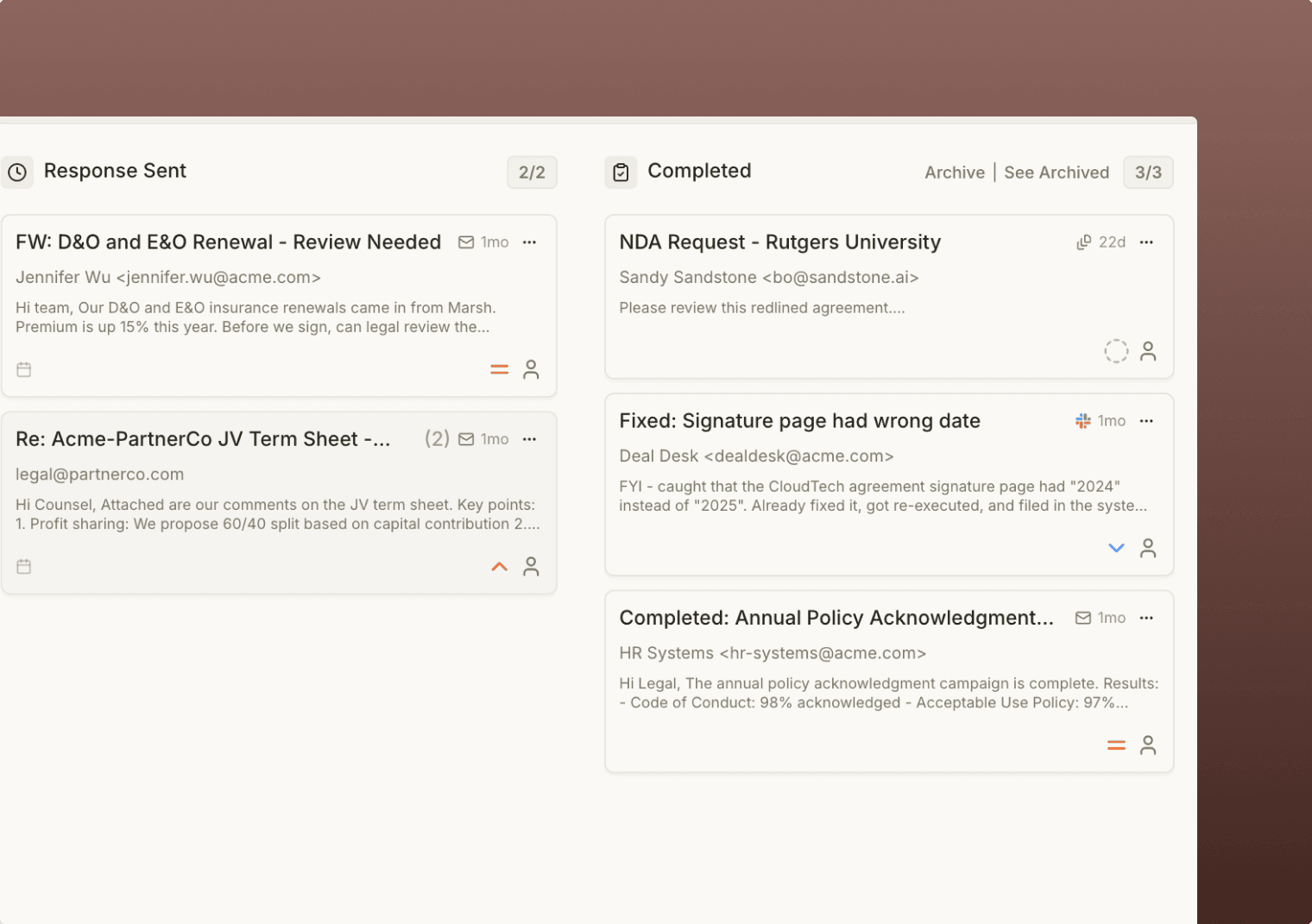
To eliminate the Context Tax, legal departments must move toward an integrated modern infrastructure. It is a system that pulls key details into one place without a lawyer needing to “hunt” for them.
The Sandstone Vision
Rather than modifying how the lawyer works, a unified system transforms how work reaches the lawyer. Acting as a sophisticated cognitive layer, it synthesizes context from communication channels and CRM systems into a singular, high-fidelity perspective. This architecture ensures that every matter is grounded in the organization's collective history the moment it is opened.
The Future Legal Department
08Visibility, Speed, and Institutional Memory
When context is successfully synthesized, the fundamental nature of the Legal department undergoes a structural evolution. The transition from reactive to a proactive strategic asset is defined by three core characteristics:
Context-Aware Institutional Intelligence
The platform serves as a permanent repository of institutional memory. By retaining every negotiation nuance and organizational preference, the system functions as a digital Senior Associate. One that maintains an infallible record of past precedents to ensure absolute continuity in counsel.
Proactive Risk Mitigation
The paradigm shifts from manual oversight to automated vigilance. Rather than awaiting a human trigger to identify contract variances, the intelligence layer preemptively flags risks based on live business playbooks. This ensures that potential liabilities are identified and addressed prior to the commencement of formal review.
Data-Informed Operational Visibility
The transition from qualitative estimation to quantitative precision allows for a sophisticated understanding of departmental output. Leadership can leverage high-fidelity “heat maps” of resource allocation to identify efficiency gaps and make data-driven decisions regarding the reclamation of outside counsel spend.
The Procurement Play
Executive Alignment: When presenting to the CFO, the narrative should pivot from “individual attorney efficiency” to “enterprise velocity.” Demonstrating that an AI-integrated infrastructure can reduce contract cycle times by 40% through the elimination of context-switching frames the investment as a direct driver of top-line revenue and a catalyst for broader business acceleration.
Tactical Execution with Sandstone
09Transforming Theory into Precision
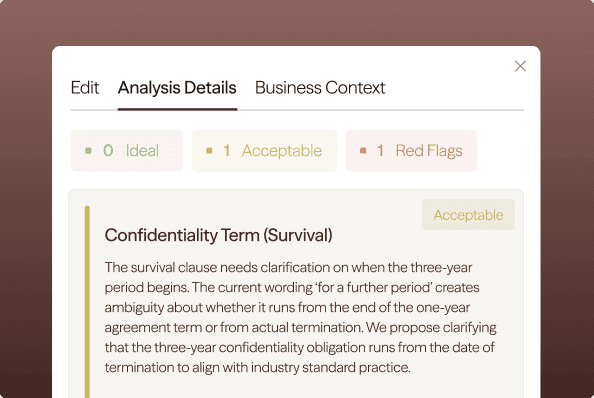
In a fragmented legal tech stack, “automated redlining” often creates more work than it saves. Without institutional context, generic tools produce “hallucinated” clauses or suggestions that conflict with established company policy. Sandstone eliminates this friction by ensuring that every tactical action is grounded in the organization’s collective intelligence.
The Sandstone “Intelligent Playbook”
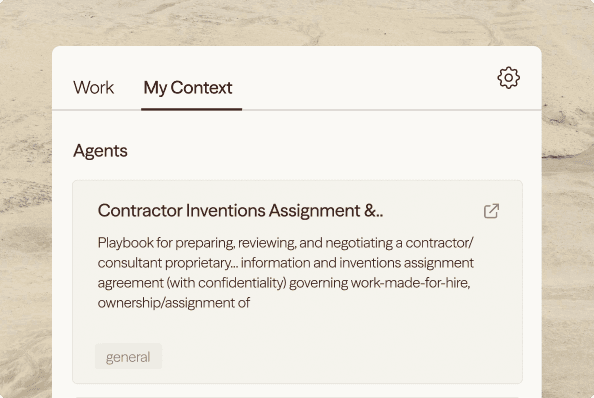
Traditional playbooks are often static documents that fail to account for the nuance of a specific execution. Sandstone transforms these into dynamic, context-aware engines.
Historical Alignment: Rather than relying on rigid “if/then” rules, Sandstone's AI analyzes current contracts against the organization's historical “Gold Standard” precedents. It automatically identifies the best-fit fallback positions based on what has actually been successfully negotiated in the past.
Contextual Sensitivity: Sandstone understands the difference between a high-stakes partnership and a routine vendor agreement, adjusting its recommendations to align with the specific risk profile of the matter at hand.
High-Fidelity First-Pass Redlining
Sandstone's platform approach allows it to handle the “commodity” cognitive load of a contract review addressing basic compliance, standardizing definitions, and applying baseline protections.
The “Clean Draft” Launchpad: The system executes initial redlining with surgical precision, ensuring the legal professional never begins a review with a “dirty” draft or a blank page.
Augmented Expertise: By surfacing the why behind a suggested change—linking back to a specific Slack discussion or a previously signed MSA—Sandstone allows the lawyer to focus their intellectual capital on high-stakes nuances rather than manual cross-referencing.
The Success Framework
10How to Measure What Matters
To ensure your AI investment delivers, you need a framework for success. Don't measure everything; measure the gaps.
1.0 The ROI Matrix
Efficiency
Reduction in time spent on initial intake and triage.
Quality
Consistency in clause usage across the entire team.
Retention
Reducing the “burnout factor” by eliminating administrative drudgery.
2.0 Identifying Your Gaps
Is your intake broken? Start with a unified intake portal.
Is your memory broken? Start with a centralized context repository.
The Ethics of Intelligence
11Security as a Strategic Moat
One security breach can be catastrophic. When evaluating Legal AI, security standards must be uncompromising.
The Training Boundary
Your data must never be used to train the vendor's global models. Your institutional knowledge is your competitive advantage; it should remain yours.
Permissions and Governance
A legal tool must respect the “need to know” basis. Just because the AI is “unified” doesn't mean the whole company should have access to sensitive legal strategy.

Red Flags
If a vendor cannot provide a clear, technical explanation of how your data is partitioned and “walled off” from their Large Language Model's general training data, they are not an enterprise-grade legal partner.
Conclusion
12Reclaiming the Strategic Seat
The transition to an AI-native legal department is not a one-time purchase; it is a strategic shift. By solving the Context Tax, you are doing more than just “buying software”—you are reclaiming the mental bandwidth of your team.
You are moving away from the era of “Human as an API” and into the era of the Strategic General Counsel.
Save for later